
Energy access & resilience
Explore the potential
of overlooked heat.
The Eco-Thermal AI Cylinder is a research concept for capturing and storing thermal energy, with proposed pathways toward useful heat and possible electricity generation.
Research conceptHow this serves the mission
Make useful energy the test of the idea.
ETAC research asks whether otherwise rejected heat can be captured, stored, or reused in a way that produces a useful, safe, and economically meaningful result. Storage, direct heat use, and possible electricity conversion are different questions. A future application must be evaluated as a complete system, including its source, losses, operating conditions, maintenance, and people served.
The problem
Why this matters.
Heat may be discarded while potential users face energy or resilience needs; useful reuse is not guaranteed.
Who is affected
People at the center.
Communities, facilities, infrastructure operators, researchers, and maintainers.
The proposed response
Investigate an exterior cylinder concept for thermal capture and storage, monitoring, and possible conversion or downstream applications.
Validated results could establish whether a useful, safe and maintainable application exists.
The original cylinder concept
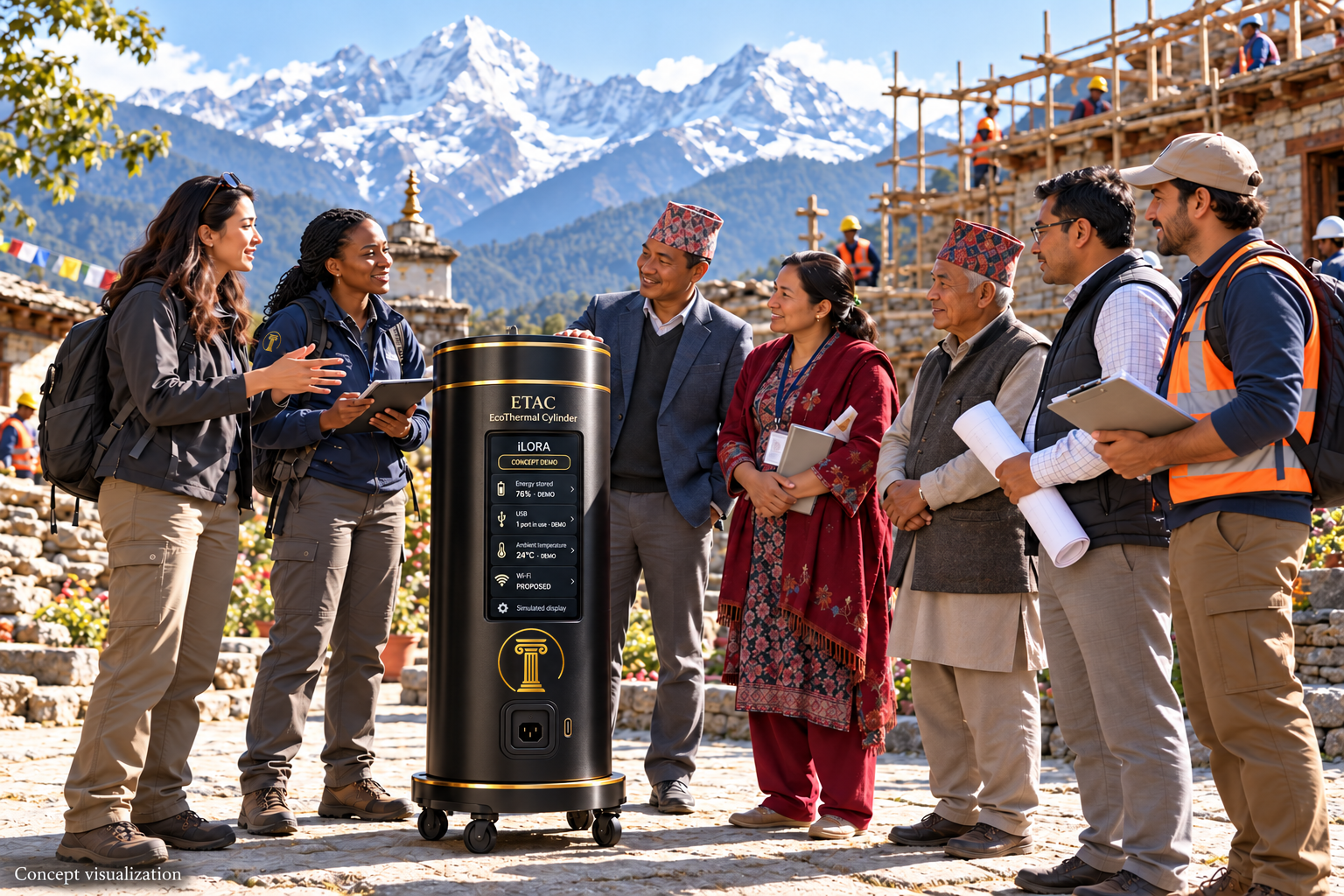
The design direction features a black cylindrical enclosure, a touchscreen, sensing, and a serviceable physical form. Its appearance communicates a design intention; it is not evidence of a manufactured or validated device.
Energy must come from somewhere
ETAC would require an external heat source and an engineered way to store or use that heat. Electricity generation would require a suitable conversion system and temperature difference. Useful output, losses, safety, and cost remain to be established.
A possible role in Nepal
The scene imagines a conversation about community energy needs in Nepal. It is not a record of deployment, field testing, local partnerships, or delivery of electricity or connectivity. Any future pilot would require local participation and validated equipment.
Explore the research questions
One concept. Several possible applications.
Select an area to see what would need to be established.
Research direction · Not validated
Thermal storage
Explore materials and an enclosure that could absorb, retain, and release heat. Capacity, losses, operating temperature, and life cycle are unverified.
ETAC exterior interface
Understandable information. Clear limits.
This is an interface illustration, not device telemetry. No measurements or performance figures are represented.
ETAC CONCEPT DEMO
External controls only
A proposed charging interaction.
The Nepal illustration shows a woman connecting a phone as a possible future use. It does not verify electrical output, successful charging, internet service, or an actual deployment.
Ambient heat alone does not guarantee electricity. Suitable sources, temperature differences, conversion, safety, and winter performance remain research questions.
Read the public research agenda →Available today
What this page offers.
The exterior visualization and interface illustration are website demonstrations. No hardware output, storage capacity, winter operation, field deployment, or charging capability is verified.
Development status
Research conceptThe described capability or program remains at the stage shown here. Images are illustrative, and no availability or performance is established by a rendering.
Explore Energy Access and Resilience →